artistic educator's perspective

《割り箸ドローイング》
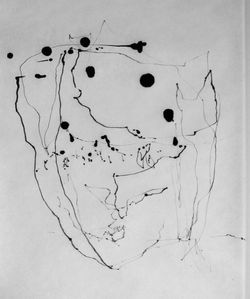
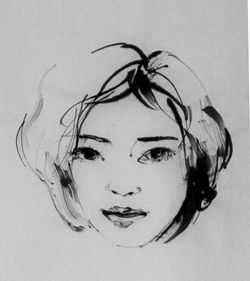
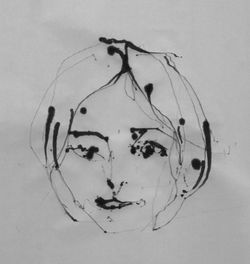
小中学校の図工でも使われる割り箸ペンに墨汁をつけ、対象を描く。最初は一本。そこから二本、三本と継ぎ足し、描画する道具を徐々に長くしていく。
一本のとき、線は対象を再現するために機能し、鑑賞者の視線は描かれた像へと向かう。しかし距離が伸び、身体による制御が失われていくにつれて形は崩れ、墨の滲み、かすれ、震え、紙との摩擦といった線や素材そのものの存在が前景化していく。
徐々に、いわゆる「下手」になっていく。
しかし、ここで起きているのは単なる描写の失敗ではない。道具の長さを一つの変数として、写実的な像と線や素材との関係が少しずつ反転していく。その変化のグラデーションを連続的に可視化する試みである。
像は、どこまで像であり続けるのか。
そしてそれが失われたとき、私たちは何を見ているのだろうか。
Chopstick Drawing
Using a chopstick pen dipped in sumi ink—a familiar tool in Japanese elementary and junior high school art classes—the artist draws from observation. He begins with a single chopstick, then joins a second, a third, and so on, gradually extending the length of the drawing implement.
With a single chopstick, the line functions primarily as a means of representation, directing the viewer’s attention toward the depicted image. As the implement grows longer and bodily control begins to diminish, forms gradually break down. The bleeding and skipping of the ink, the trembling of the line, and the friction between pen and paper increasingly come to the fore.
The drawing becomes, in conventional terms, progressively “worse.”
Yet what takes place here is not simply a failure of representation. By treating the length of the tool as a single variable, the work gradually reverses the relationship between the represented image and the material presence of line and ink, rendering that transition visible as a continuum.
How long does an image remain an image?
And when it ceases to be one, what is it that we are looking at?

 |
|---|
 |
 |
 |
 |
 |
 |
 |
 |
 |
 |
|---|
 |
 |
 |
 |
 |
 |
 |
|---|
 |
 |
 |
 |
 |
 |
 |
 |
 |
 |
 |
|---|
 |
 |
 |
 |
 |
 |
 |
 |


